Hydrogen production via direct seawater electrolysis is an ideal pathway for a sustainable energy transition and a net-zero carbon future. However, during the anodic oxygen evolution reaction (OER), high concentrations of chloride ions (Cl-) in seawater trigger severe competing reactions (the chlorine evolution reaction) and catalyst corrosion, leading to the rapid deactivation of conventional electrocatalysts. Layered FeNi double hydroxides (FeNiLDH) have garnered significant attention due to their unique 2D layered structure and excellent intrinsic OER activity. Nevertheless, their open interlayer spaces are highly susceptible to Cl- ingress under the high-salinity and high-potential environments of the anode. Meanwhile, the confined interlayer microenvironment of FeNiLDH, particularly the interfacial water molecule network, plays a decisive role in its OER catalytic activity and stability. Yet, precise molecular-level regulation of this specific region remains a formidable challenge. In light of this, a collaborative research team led by Professor Shihe Yang from Peking University Shenzhen Graduate School, Professor Zhengxiao Guo from the University of Hong Kong, and Professor Jue Hu from Kunming University of Science and Technology has reported a strategy to reshape the active sites and interlayer microenvironment of FeNiLDH through the intercalation of amphiphilic molecules, achieving highly selective and highly stable seawater oxidation.
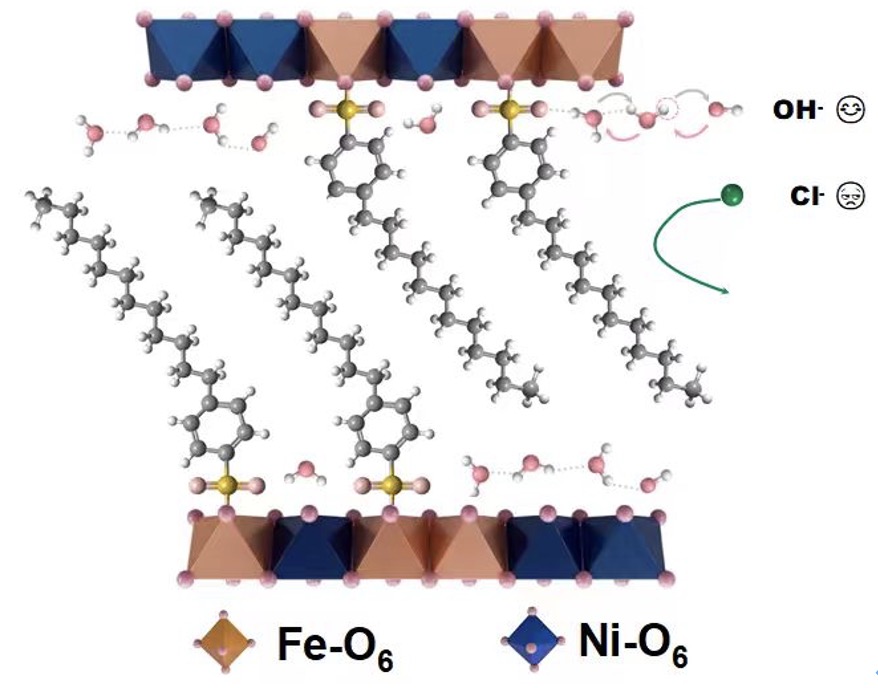
Combining experiments and theoretical calculations, the research team broke the limitations of traditional layered FeNi double hydroxides (FeNiLDH), which rely on weak electrostatic interactions to stabilize interlayer anions. They proposed establishing irreversible, strong Fe-O-S coordination bonds between amphiphilic molecules with self-assembling capabilities and the active centers of the catalyst. Using sodium dodecylbenzenesulfonate (SDBS) as a model, they constructed a "coordination-supramolecular locked" interlayer microenvironment. Density functional theory (DFT) calculations revealed that this strong coordination upshifts the d-band center of Fe and significantly enhances Fe-O covalency, thereby drastically lowering the thermodynamic energy barrier for the OER. Simultaneously, molecular dynamics (MD) simulations demonstrated that the hydrophobic alkyl chain arrays of SDBS can dynamically reorganize the local hydration shell (the interfacial hydrogen bond network), forming a robust kinetic barrier against Cl- invasion. Meanwhile, it preserves a rapid inward transport channel for hydroxide (OH-) via the Grotthuss mechanism, achieving an exceptionally high OH-/Cl- selectivity (diffusion coefficient ratio DOH-/DCl- ≈ 1.94).
Benefiting from these dual advantages at the atomic-level interface, the NiFe-SDBS catalyst successfully breaks the inherent trade-off between activity and stability that has long plagued seawater electrolysis. Outstandingly, it not only maintains an ultralow overpotential of 239 mV at 10 mA/cm2, but also operates stably in alkaline seawater at an industrial-grade current density of 1000 mA/cm2 for over 1000 hours with almost zero degradation. Furthermore, the team integrated the electrode into an anion exchange membrane (AEM) electrolyzer to demonstrate its operational stability at an industrial current density of 1000 mA/cm2, validating its highly competitive low energy consumption (~4.64 kWh/Nm3). It also operated stably for over 600 hours at 500 mA/cm2 with an ultra-low degradation rate (only 0.18 mV/h). The coordination-driven microenvironment engineering proposed in this work is not only applicable to specific nickel-iron systems but also broadly provides a universal and rational design paradigm for engineering highly robust catalytic interfaces in complex, impurity-rich electrochemical environments. More importantly, the strong interaction between the hydrophilic groups and the intra-layer metal sites reorganizes the interfacial water molecule network and optimizes the adsorption energy of reaction intermediates, thereby significantly lowering the OER energy barrier and accelerating electron transfer. The optimized intercalated catalyst exhibits extraordinary corrosion resistance and highly efficient water oxidation kinetics in both simulated and real seawater electrolytes. From the perspective of molecular engineering, this work reveals the profound impact of the interlayer microenvironment and interfacial water network on the electrocatalytic performance of low-dimensional materials, opening an entirely new pathway for the design of long-lifespan, highly selective direct seawater electrolysis catalysts.
This work was recently published in the top-tier materials journal Advanced Materials under the title "TAmphiphilic Bonding Intercalation Reshapes Active Sites and Interlayer Microenvironment for Selective and Stable Seawater Oxidation in Advanced Materials".
The first author of this paper is PhD student Feng Dong from the research group, and the corresponding authors are Professor Shihe Yang, Professor Zhengxiao Guo, and Professor Jue Hu. This work was supported by the National Natural Science Foundation of China, the Key Project of Frontier and New Materials of Guangdong Province, the Guangdong-Israel Cooperation Fund, the Shenzhen Science and Technology Plan Project, the Shenzhen Innovation Fund, and the Shenzhen Peacock Plan.
Link to the paper: http://doi.org/10.1002/adma.73812