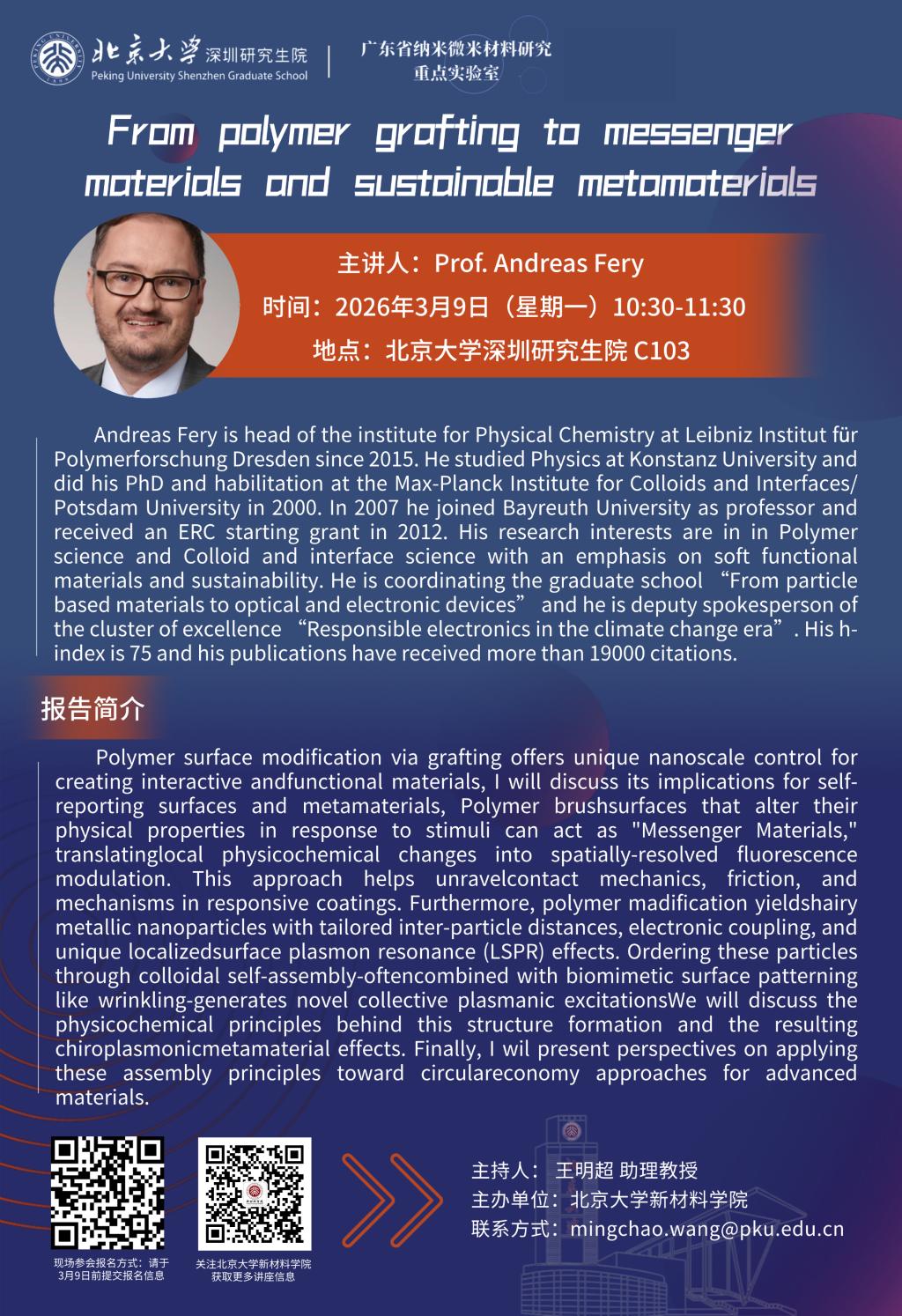
讲座时间:2026年3月9日(星期一)10:30-11:30
讲座地点:北京大学深圳研究生院 C103会议室
主讲人:德累斯顿莱布尼茨聚合物研究所 Andreas Fery教授
报告摘要/Abstract:
Polymer surface modification offers unique possibilities for creating interactive and functional materials. Polymer grafting in particular can be employed for nanoscale control both on macroscopic surfaces and for nanoparticles. I will discuss the implications for self-reporting surfaces and metamaterials.
Polymer brush surfaces that alter their physical properties in response to chemical stimuli have the capacity to be used as so-called Messenger Materials. These materials translate local physicochemical changes into spatially-resolved modulation of fluorescence [1]. This approach can be used for unraveling contact mechanics and friction in complex scenarios, as well as clarify mechanisms acting in responsive and adaptive surface coatings [2].
Polymer modification of nanoparticles results in hairy nanoparticles, which find a range of applications in functional materials [3]. Especially metallic nanoparticles offer a number of interesting optical and electronic effects due to their localized surface plasmon resonance (LSPR). Adding a functional polymeric shell does not only allow controlling inter-particle distances but as well tailored transport / electronic coupling [3,4]. Increasing the level of complexity, the ordering of particles at different length scales opens another powerful route to optical and electronic functionality due to novel collective plasmonic excitations arising from plasmonic coupling effects. We focus on achieving such ordered particle arrays through self-assembly approaches. Colloidal self-assembly can indeed yield well-defined colloidal clusters and surface arrays in which coupling effects can be controlled. In particular, large-scale assemblies are possible in combination with biomimetic surface patterning like controlled wrinkling. We discuss the underlying physicochemical principles of the structure formation process and the resulting plasmonic coupling effects including chiroplasmonic metamaterial effects [5,6]. Finally, we present perspectives on how these assembly principles can be relevant for developing circular economy approaches for advanced materials.
主讲人介绍/Biography:
Andreas Fery is head of the institute for Physical Chemistry at Leibniz Institut für Polymerforschung Dresden since 2015. He studied Physics at Konstanz University and did his PhD and habilitation at the Max-Planck Institute for Colloids and Interfaces/Potsdam University in 2000. In 2007 he joined Bayreuth University as professor and received an ERC starting grant in 2012. His research interests are in in Polymer science and Colloid and interface science with an emphasis on soft functional materials and sustainability. He is coordinating the graduate school “From particle based materials to optical and electronic devices” and he is deputy spokesperson of the cluster of excellence “Responsible electronics in the climate change era”. His h-index is 75 and his publications have received more than 19000 citations.