讲座时间:2026年11月21日(星期六)09:00-09:45
讲座地点:北京大学深圳研究生院 C103
主讲人:迪肯大学 Prof. Roger Horn
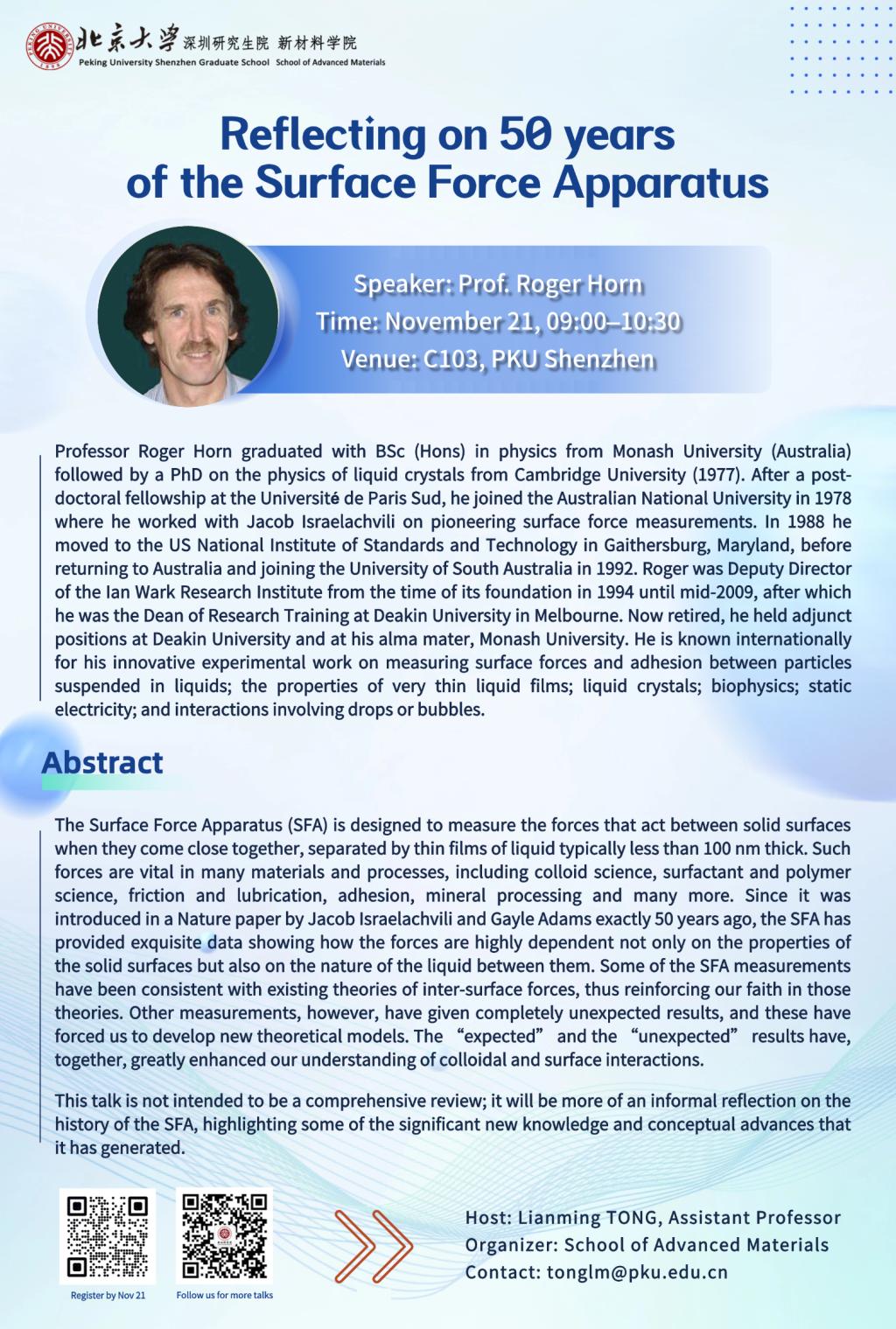
报告摘要/Abstract:
The Surface Force Apparatus (SFA) is designed to measure the forces that act between solid surfaces when they come close together, separated by thin films of liquid typically less than 100 nm thick. Such forces are vital in many materials and processes, including colloid science, surfactant and polymer science, friction and lubrication, adhesion, mineral processing and many more. Since it was introduced in a Nature paper by Jacob Israelachvili and Gayle Adams exactly 50 years ago, the SFA has provided exquisite data showing how the forces are highly dependent not only on the properties of the solid surfaces but also on the nature of the liquid between them. Some of the SFA measurements have been consistent with existing theories of inter-surface forces, thus reinforcing our faith in those theories. Other measurements, however, have given completely unexpected results, and these have forced us to develop new theoretical models. The “expected” and the “unexpected” results have, together, greatly enhanced our understanding of colloidal and surface interactions.
This talk is not intended to be a comprehensive review; it will be more of an informal reflection on the history of the SFA, highlighting some of the significant new knowledge and conceptual advances that it has generated.
主讲人介绍/Biography:
Professor Roger Horn graduated with BSc (Hons) in physics from Monash University (Australia) followed by a PhD on the physics of liquid crystals from Cambridge University (1977). After a post-doctoral fellowship at the Université de Paris Sud, he joined the Australian National University in 1978 where he worked with Jacob Israelachvili on pioneering surface force measurements. In 1988 he moved to the US National Institute of Standards and Technology in Gaithersburg, Maryland, before returning to Australia and joining the University of South Australia in 1992. Roger was Deputy Director of the Ian Wark Research Institute from the time of its foundation in 1994 until mid-2009, after which he was the Dean of Research Training at Deakin University in Melbourne. Now retired, he held adjunct positions at Deakin University and at his alma mater, Monash University. He is known internationally for his innovative experimental work on measuring surface forces and adhesion between particles suspended in liquids; the properties of very thin liquid films; liquid crystals; biophysics; static electricity; and interactions involving drops or bubbles.