Recently, the research team of Prof. Shihe Yang from, in collaboration with the team of tenured Associate Prof. Hang Zhou from the School of Electronic and Computer Engineering, published a research paper titled "Self-assembled 1D/3D heterojunction enables all-inorganic perovskite 4-terminal tandem solar cells with 21.54% certified efficiency" in the prestigious international journal Nature Communications. The team employed a bifunctional zwitterionic molecule – tetrabutylammonium trifluoromethanesulfonate (TTFS) – to construct an in-situ 1D/3D heterojunction on the surface of all-inorganic perovskite (CsPbI₃₋ₓBrₓ), achieving a certified power conversion efficiency of 21.54%. This value represents the highest reported efficiency to date for all-inorganic perovskite four-terminal tandem solar cells.
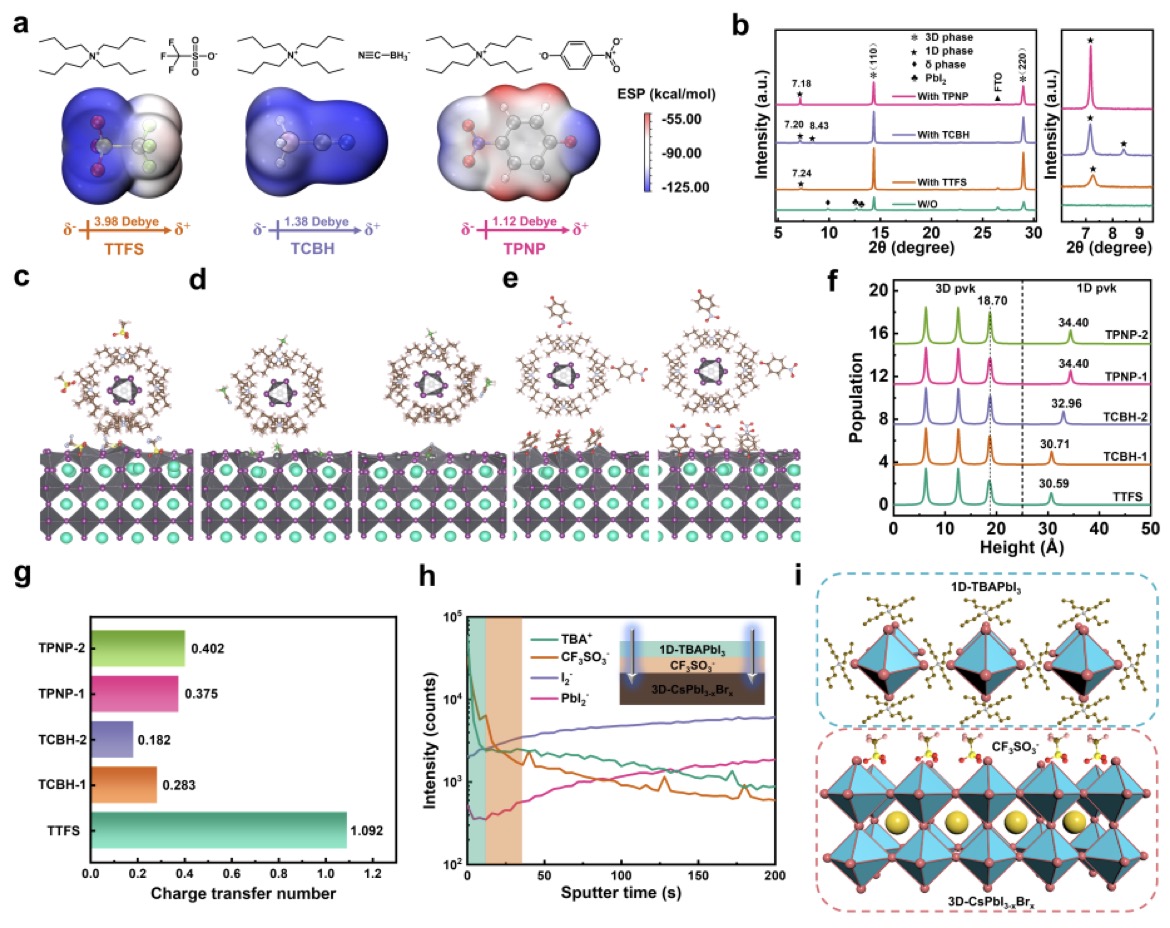
Figure 1: Illustration of the zwitterionic surface reconstruction mechanism enabled by TTFS through anion-regulated assembly of pure-phase 1D structures, reduction of interfacial spacing, and enhancement of charge transfer, achieving a synergistic "cation-barrier and anion-passivation" effect.
All-inorganic perovskite solar cells have attracted significant attention due to their excellent thermal and light stability. However, moisture-induced lattice collapse and interfacial defect enrichment have long constrained improvements in both efficiency and environmental stability. To address these challenges, the research team proposed a novel synergistic strategy of "cation barrier and anion passivation." The tetrabutylammonium cation (TBA⁺) in the TTFS molecule undergoes in-situ self-assembly on the perovskite surface, forming a dense hydrophobic 1D-TBAPbI₃ protective layer that effectively blocks moisture and oxygen ingress. The trifluoromethanesulfonate anion (CF₃SO₃⁻) is distributed in the subsurface region, precisely passivating undercoordinated Pb²⁺ defects through strong coordination, thereby significantly suppressing non-radiative recombination. First-principles calculations show that this 1D/3D heterojunction exhibits the smallest interfacial spacing and the largest interfacial charge transfer, thus constructing a rapid electron extraction channel and overcoming the traditional trade-off between stability and charge transport efficiency found in conventional low-dimensional passivation strategies.
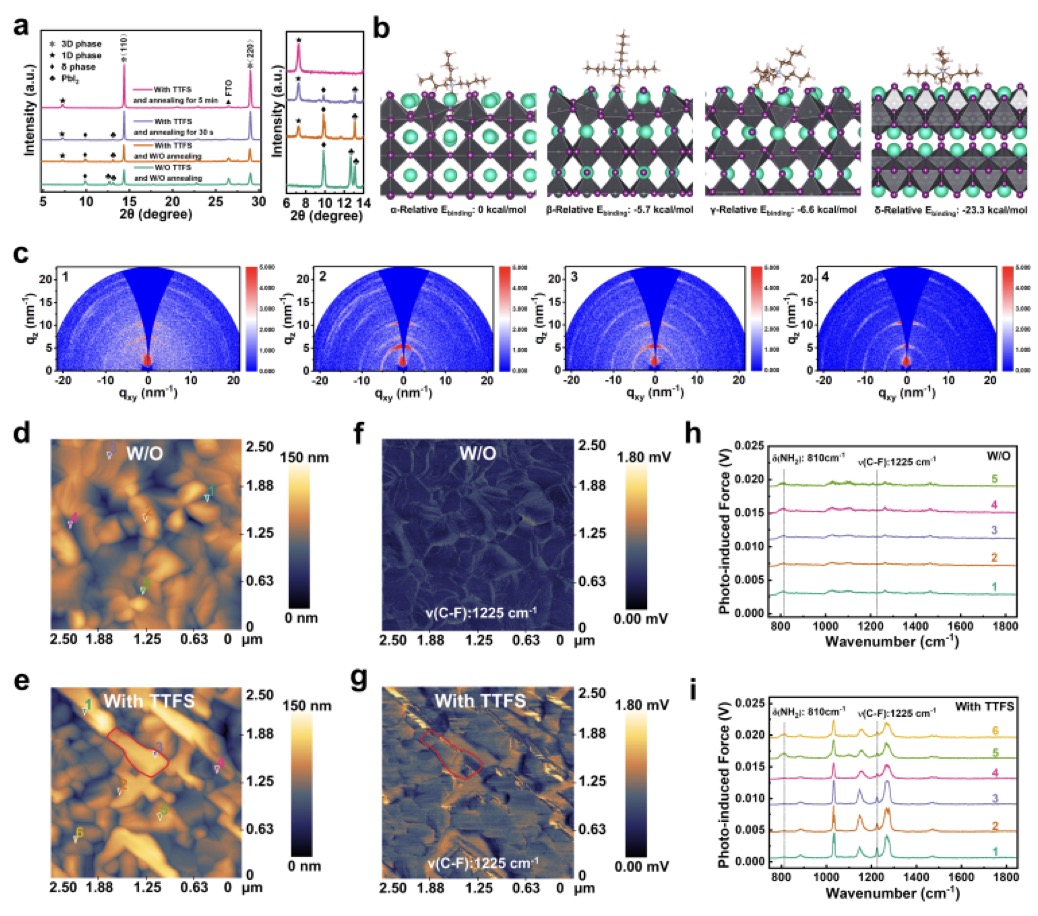
Figure 2: Through XRD, GIWAXS, and AFM-IR, the study reveals the dynamic process where TTFS preferentially converts the δ-phase and forms a low-dimensional perovskite via in-situ self-assembly, ultimately resulting in the 1D-TBAPbI₃ phase being predominantly distributed at the surface elongated grains.
Based on TTFS optimization, the semitransparent wide-bandgap all-inorganic perovskite top cell achieved a certified efficiency of 17.10%. When integrated with a narrow-bandgap CsPb₀.₆Sn₀.₄I₃ bottom cell, the four-terminal tandem configuration achieved a certified efficiency of 21.54%. In terms of stability, the unencapsulated optimized devices achieved a T80 lifetime (time to 80% of initial efficiency) of 650 hours under maximum power point tracking (ISOS-L-2 conditions) at 85°C under continuous 1-sun illumination. At 65°C, the T80 reached 1210 hours. This stability ranks among the highest levels reported for all-inorganic perovskite solar cells.
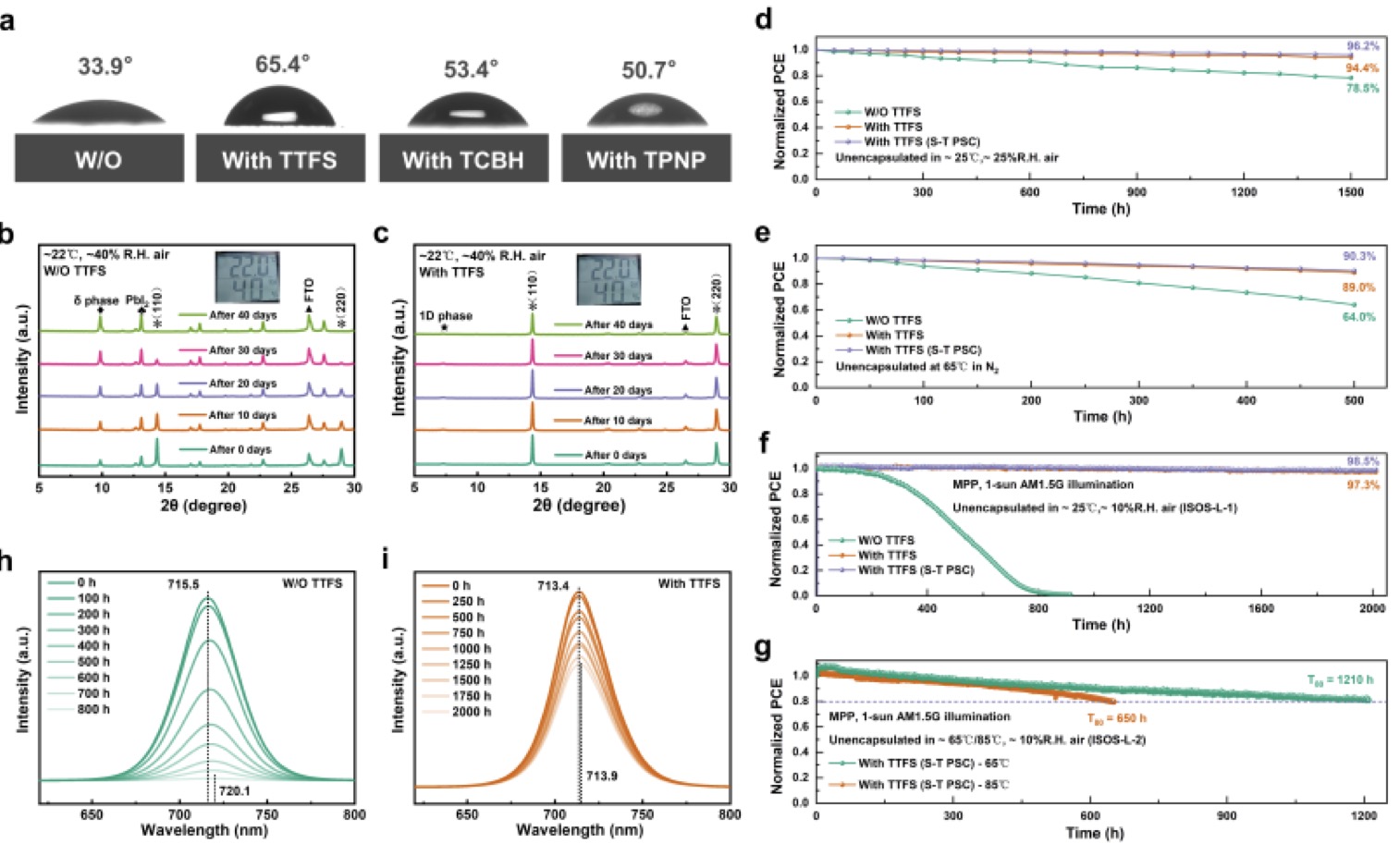
Figure 3: Multi-dimensional tests, including water contact angle, accelerated storage under heat and humidity, and ISOS-L-1 and ISOS-L-2 operational stability, comprehensively verify that the TTFS-induced 1D/3D heterojunction endows devices with excellent hydrophobicity and long-term stability. Under illumination at 85°C, T80 reaches 650 hours, and no phase separation redshift is observed in the photoluminescence (PL) spectra after aging.
Professor Shihe Yang from the School of Advanced Materials, tenured Associate Professor Hang Zhou from the School of Electronic and Computer Engineering, Dr. Mingyu Hu from Ludong University, and Professor Yanhong Lin from the Hong Kong University of Science and Technology are the co-corresponding authors of this paper. Hao Zhang, a doctoral student in the research group, is the first author. This research work was supported by the National Natural Science Foundation of China (NSFC), the Guangdong-Israel Cooperation Fund, the Shenzhen Science and Technology Program, the Shenzhen Innovation Fund, and the Shenzhen Peacock Talent Program.
Paper link:https://doi.org/10.1038/s41467-026-72099-z