Recently, Ligang Wang’s group from the School of Advanced Materials, Peking University, in collaboration with the Shenzhen International Quantum Academy (SIQA) and KTH Royal Institute of Technology, published a review article on mid-infrared superconducting single-photon detectors. The article, entitledSuperconducting nanowires for mid-infrared single-photon detectors, was published online on May 20, 2026, inDevice, a journal published by Cell Press.
Mid-infrared single-photon detection (2–30 μm) is of great importance for a broad range of applications, including dark matter detection, quantum communication, molecular spectroscopy, LiDAR, and gas sensing. Superconducting nanowire single-photon detectors (SNSPDs) offer exceptional performance, including high detection efficiency, ultralow dark count rates, and excellent timing resolution, and have become one of the most advanced single-photon detection technologies. Recent advances in superconducting materials, nanofabrication, and cryogenic optical technologies have extended the operating wavelength of SNSPDs from the visible and near-infrared into the mid-infrared, enabling the exploration of light–matter interactions at much lower energy scales.
This review provides a comprehensive overview of the current status and key challenges of mid-infrared SNSPDs. It summarizes the core strategies for achieving high-performance detection, including superconducting material selection, device architecture design, optical coupling schemes, and readout optimization. The article compares the characteristics of polycrystalline materials such as NbN and NbTiN with amorphous materials including WSi, MoSi, and WGe, and analyzes their respective advantages and trade-offs in terms of operating temperature, detection efficiency, timing performance, and accessible wavelength range.
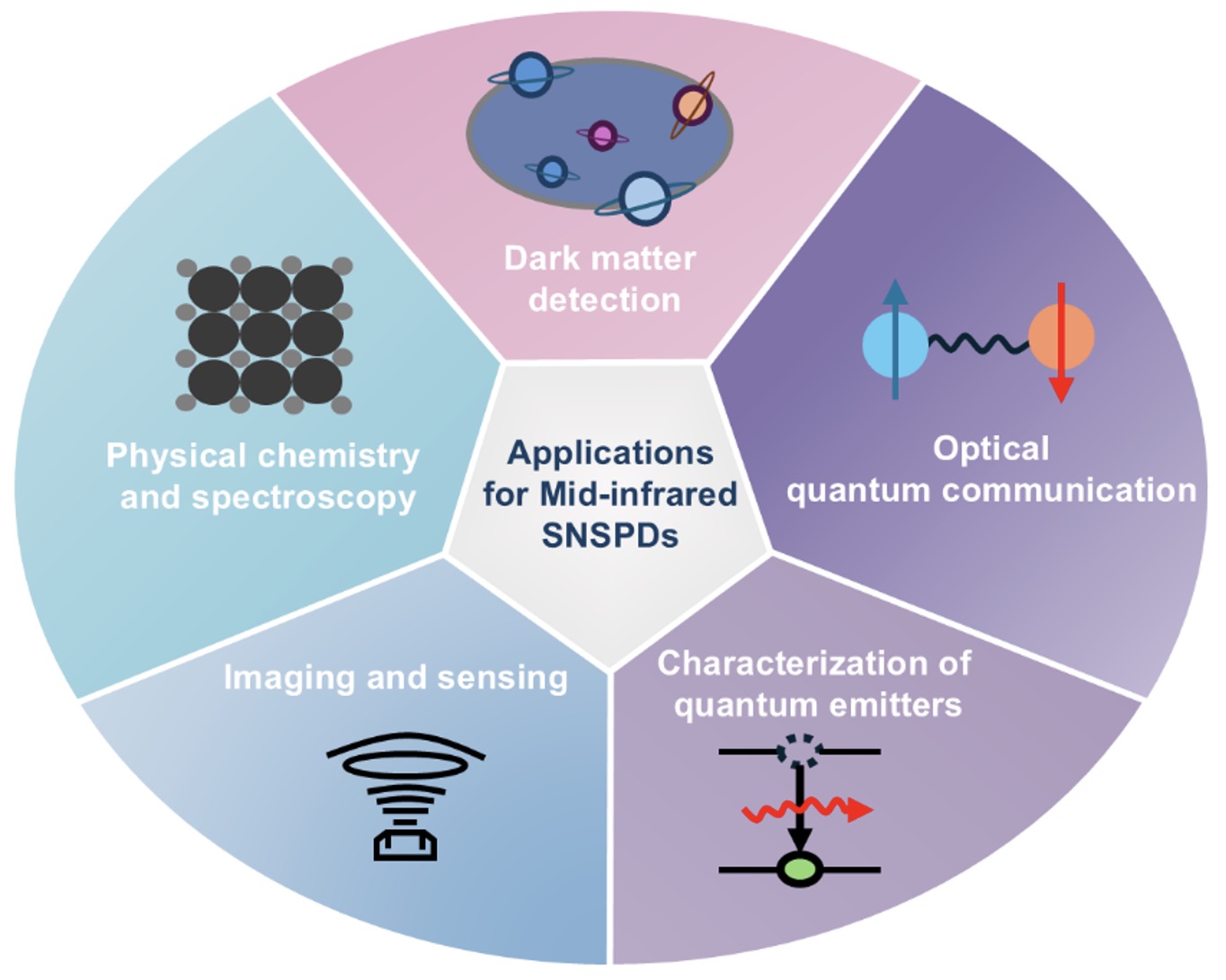
The review further highlights representative applications of mid-infrared SNSPDs in direct dark matter searches, free-space quantum communication, characterization of quantum emitters, ultrasensitive vibrational spectroscopy, single-photon LiDAR, and high-sensitivity gas sensing. It also discusses future directions toward large-scale arrays, on-chip integration, and practical deployment. The authors conclude that mid-infrared SNSPDs are poised to become key enabling technologies for quantum information science, precision measurement, and advanced sensing.
Yan Chen, Research Assistant in Professor Wang’s group, is the first author of the paper, and Professor Ligang Wang is the corresponding author. Dr. Shuqian Qiao, Academician Dapeng Yu, and Professor Val Zwiller also contributed to this review. This work was supported by the National Natural Science Foundation of China and the Shenzhen Science and Technology Program.
Paper link:https://doi.org/10.1016/j.device.2026.101165