Building windows are important pathways for solar radiation entering indoor spaces and for heat exchange between buildings and the outdoor environment, directly affecting cooling, heating, and lighting energy consumption. With the widespread use of large-area glass curtain walls in modern architecture, smart window materials capable of on-demand solar regulation have become an important direction for low-carbon and energy-efficient buildings. Among various smart window technologies, electrochromic smart windows have attracted broad attention because they can reversibly tune optical spectra under an applied voltage. However, existing electrochromic materials still struggle to independently optimize visible and near-infrared (NIR) modulation. Enhanced NIR blocking is often accompanied by reduced visible transmittance, causing indoor dimming and additional lighting energy demand. Meanwhile, some polymer systems exhibit asynchronous or even reverse visible/NIR responses: the neutral state absorbs strongly in the visible region, whereas pronounced NIR absorption only appears in the oxidized state. Achieving efficient NIR heat blocking while preserving bright indoor daylight therefore remains a key challenge for electrochromic smart windows in energy-efficient buildings.
To address this challenge, the Meng group at the School of Advanced Materials, Peking University, proposed a molecular design strategy based on “spectral decoupling” and designed a quinoid donor–acceptor polymer, P(EDOT–TQ–EDOT–ProDOT). The strongly electron-withdrawing TQ unit serves as the acceptor, while electron-rich EDOT bridging units are introduced to improve backbone planarity, enhance charge delocalization, and stabilize oxidized-state polaron species.This molecular design confines oxidized-state polaron absorption primarily to the NIR region, allowing solar heat attenuation while retaining visible transparency.Theoretical calculations and experimental results demonstrate that the EDOT-bridged quinoid donor–acceptor backbone is crucial for achieving a “bright-and-cool” smart window operating mode.
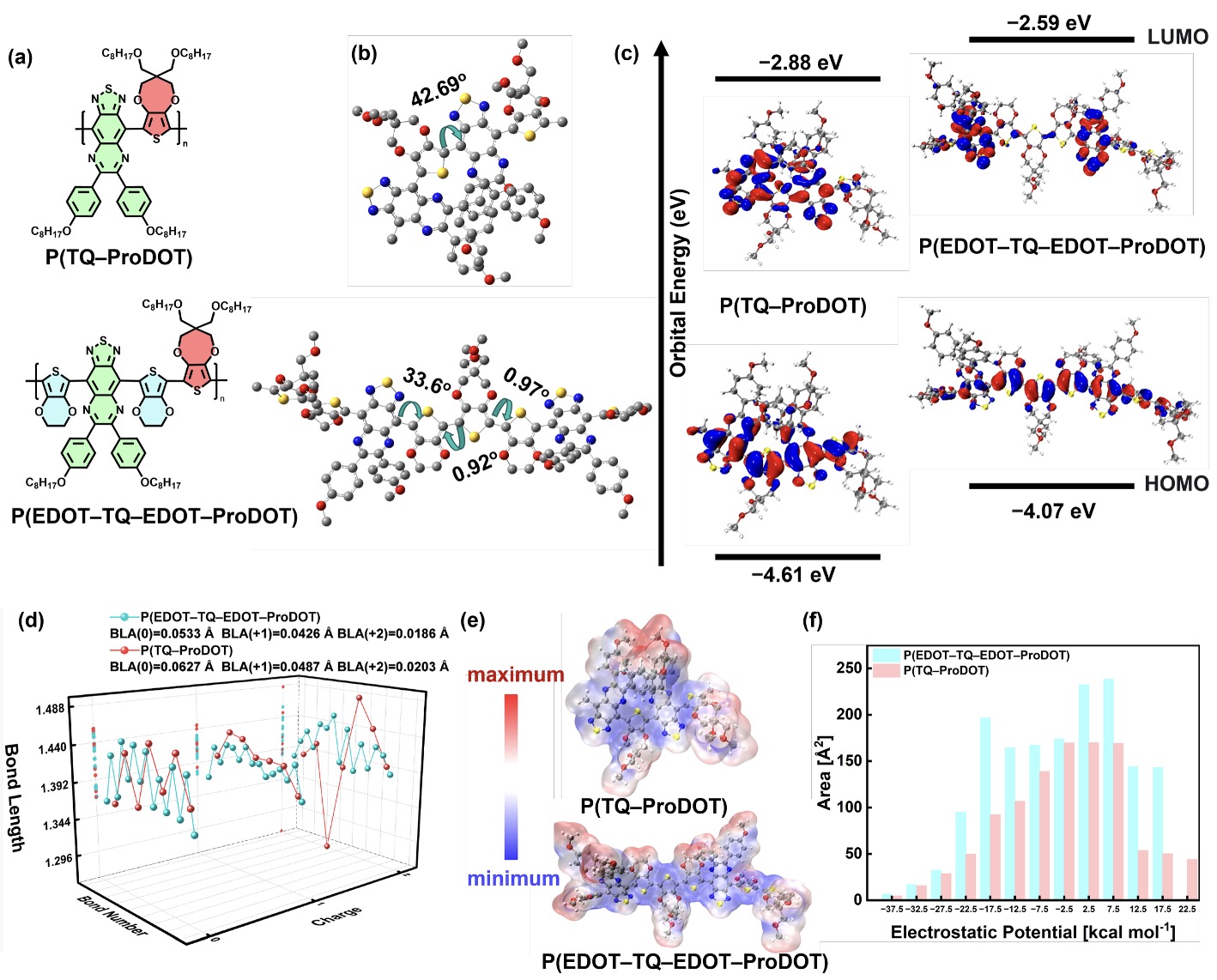
Fig 1. Molecular design, theoretical calculations, and electronic-structure analysis of the quinoid donor–acceptor polymer.
Spectroelectrochemical measurements show that, compared with P(TQ–ProDOT), P(EDOT–TQ–EDOT–ProDOT) exhibits significantly enhanced NIR modulation during oxidation. The polymer film delivers an NIR transmittance change of 78.7% at 1252 nm, while keeping visible-region changes below 10%, achieving a strong NIR response with minimal visible-light perturbation.
The team further fabricated a solid-state electrochromic device using Prussian Blue (PB) as the counter electrode. At a low driving voltage of 0.6 V, the device achieves 56.7% NIR transmittance modulation while maintaining a visible transmittance change below 5%, demonstrating a “visually silent” NIR-selective switching feature. In addition, the device exhibits a high general color rendering index (Ra > 85), fast switching response (< 4 s), high coloration efficiency (1319 cm2C-1), and stable operation over 10,000 cycles.
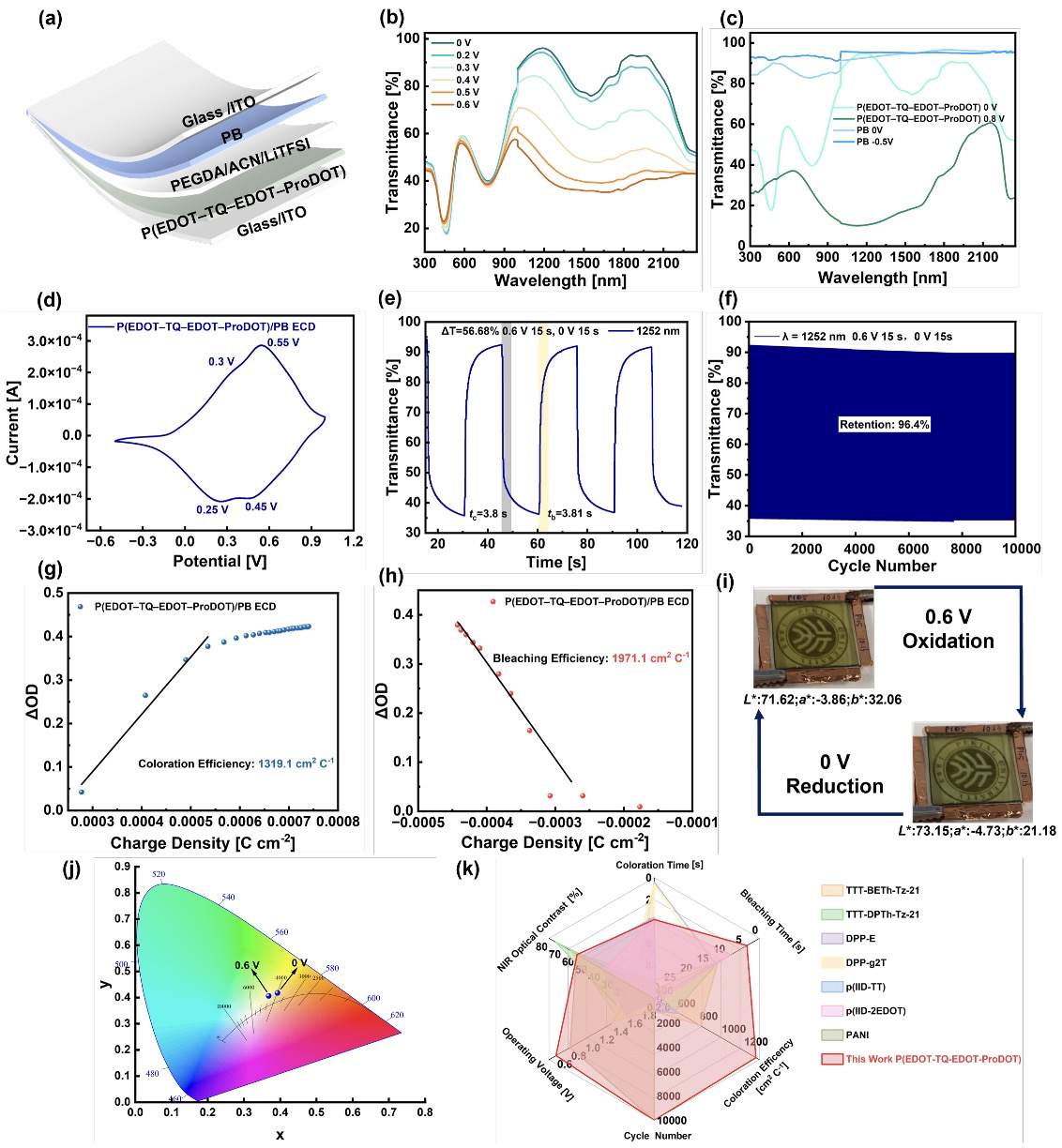
Figure 2. Structure and performance of the NIR-selective electrochromic device.
To evaluate the application potential for smart windows, the researchers conducted infrared thermal-management experiments and building energy simulations based on Guangzhou climate data. The results show that the device can effectively reduce indoor heat accumulation and lower cooling demand while maintaining visible-light transmission. Energy simulations indicate that, compared with standard double-glazed windows, the smart window can reduce annual cooling energy consumption by 9.32 kWh m-2. Even after considering lighting energy consumption, it still achieves a net annual energy saving of 3.41 kWh m-2, highlighting its potential for low-carbon building envelopes.
Overall, this work demonstrates that organic electrochromic materials can simultaneously achieve strong NIR shielding and high visible-light retention through rational molecular design of EDOT-bridged quinoid donor–acceptor polymers. It provides a new molecular design strategy for next-generation electrochromic smart windows that combine energy-saving performance with indoor visual comfort.
The related work, entitled “Bright-and-Cool Smart Windows: Visually Silent and Near-Infrared Modulation via Quinoid Donor–Acceptor Polymers,” has been published in Advanced Energy Materials.
Prof. Hong Meng and Dr. Yaowu He from the School of Advanced Materials, Peking University, are the co-corresponding authors of the paper. Master’s studentSiqin Sunis the first author. This work was supported by Shenzhen Science and Technology Program, National Natural Science Foundation of China, Guangdong Key Laboratory of Flexible Optoelectronic Materials and Devices, Guangdong Engineering Technology Research Center of Multi-Dimensional Optoelectronic Material, Shenzhen Key Laboratory of Organic Optoelectromagnetic Functional Materials of Shenzhen Science and Technology Plan, and Guangdong Provincial International Science and Technology Cooperation Project.
Link to the paper: https://doi.org/10.1002/aenm.71060