A collaborative research team led by Professors Ruqiang Zou and Mingchao Wang from the School of Advanced Materials, Peking University Shenzhen Graduate School, has developed a novel approach for fabricating highly crystalline two-dimensional (2D) conjugated polymers. Published in Nature Chemistry, the work introduces a Mannich–elimination synthetic strategy that enables precise control over crystallization, addressing a long-standing challenge in the field.
2D conjugated covalent organic frameworks (COFs), particularly vinylene-linked variants known as 2D poly(arylene vinylene)s, are highly promising for applications in (opto)electronics, photocatalysis, and electrochemistry. They offer superior in-plane π-conjugation compared to conventional imine-linked frameworks. However, limited controllability in traditional polymerization methods has restricted the crystalline domain size of these materials to less than 20 nanometers, hindering performance optimization and practical applications. Achieving both high crystallinity and structural stability has remained a key bottleneck.
To overcome this challenge, the research team—including scientists from Technische Universität Dresden, the Max Planck Institute, and the College of Chemistry and Molecular Engineering at Peking University—employed a reversible C=C bond formation process via a Mannich–elimination sequence. Using this approach, they successfully transformed eight types of 2D polyimines into eleven highly crystalline 2D poly(arylene vinylene) derivatives, demonstrating precise control over crystallization behavior.
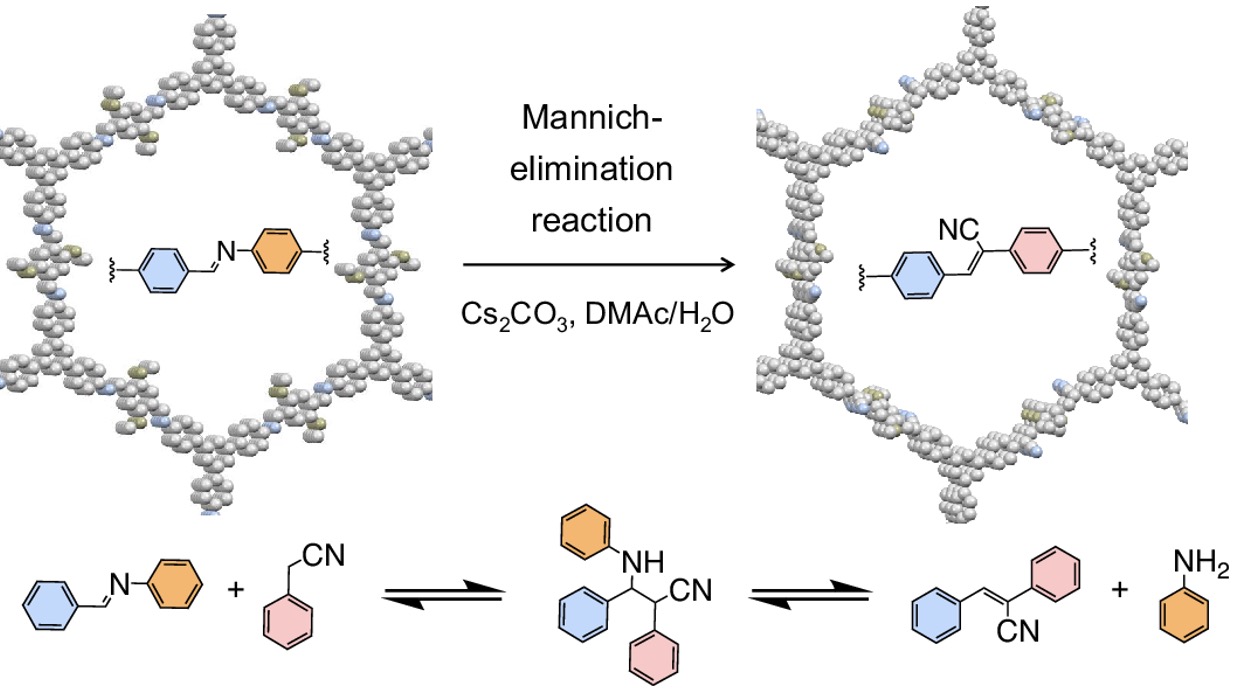
Figure 1. Synthesis of highly crystalline 2D poly(arylene vinylene) frameworks via the Mannich–elimination strategy.
The method offers a general route to structurally robust 2D poly(arylene vinylene)s with diverse lattice types, including honeycomb, square, and kagome topologies. The resulting materials exhibit surface areas up to approximately 2,000 m²/g and show a high lattice mismatch tolerance of up to 3.5%. Using high-resolution transmission electron microscopy and continuous rotation electron diffraction, the team confirmed that a triphenylbenzene-based 2D poly(arylene vinylene) forms single crystals up to 2 micrometers in size, reflecting a high degree of molecular-scale order. Performance evaluations further revealed that crystallinity plays a decisive role in the charge transport properties of these materials.
This work provides a versatile and efficient route for the controlled synthesis of highly crystalline 2D conjugated polymers, establishing a material foundation for their use in high-stability electronic and optoelectronic devices.
The study, titled “Towards single-crystalline two-dimensional poly(arylene vinylene) covalent organic frameworks,” was published in Nature Chemistry. Professor Ruqiang Zou and Assistant Professor Mingchao Wang from Peking University, together with Professor Xinliang Feng from the Max Planck Institute of Microstructure Physics, are the corresponding authors. The research was supported by the National Natural Science Foundation of China.
Link to the paper: https://www.nature.com/articles/s41557-025-02048-8