A research team led by Prof. Wang Mingchao from the School of Advanced Materials, Peking University Shenzhen Graduate School, in collaboration with international partners including the Max Planck Institutes, has developed a new class of two-dimensional (2D) conjugated polymers with substantially enhanced charge-carrier mobility. The work, published in Nature Communications, addresses a critical challenge in organic electronics: improving in-plane conjugation and charge transport in 2D poly(arylene vinylene)s (2D PAVs).
Layered 2D conjugated polymers are promising organic crystalline materials for applications in optoelectronic devices and photocatalysis. Among them, 2D PAVs synthesized via Knoevenagel or aldol polycondensation offer superior chemical and thermal stability and stronger π-conjugation compared with conventional imine- or pyrazine-linked 2D polymers. However, previously reported 2D PAVs generally suffer from insufficient in-plane conjugation and weak band dispersion, leading to charge transport dominated by hopping mechanisms with carrier mobilities typically below 10 cm² V⁻¹ s⁻¹—a major limitation for high-performance organic electronics.
To overcome this bottleneck, the team proposed and implemented a donor–acceptor (D–A) molecular engineering strategy. Guided by theoretical calculations for monomer screening, they combined a thienobenzodithiophene donor unit with a diketopyrrolopyrrole acceptor unit to construct two novel layered D–A-type 2D PAVs.
Theoretical calculations revealed strongly dispersed electronic bands and remarkably low in-plane carrier effective masses ranging from 0.036 to 0.159 m₀ (where m₀ is the free electron mass), corresponding to intrinsic charge-carrier mobilities approaching 2000 cm² V⁻¹ s⁻¹. The experimentally prepared crystalline 2D polymers exhibited an optical bandgap as low as 1.0 eV. Further characterization using optical-pump terahertz-probe spectroscopy showed a carrier scattering time of up to 76 fs at room temperature and a carrier mobility of 310 cm² V⁻¹ s⁻¹, providing direct evidence for the effectiveness of the donor–acceptor approach in enhancing charge transport in 2D conjugated polymers.
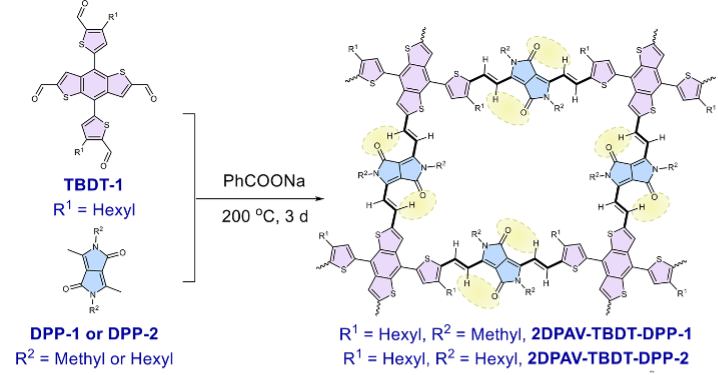
Figure 1. Design and fabrication of donor–acceptor-type 2D poly(arylene vinylene) crystalline materials.
The findings are published under the title “Diketopyrrolopyrrole-Based Two-Dimensional Poly(Arylene Vinylene)s with High Charge Carrier Mobility”. The corresponding authors are Professor Xinliang Feng and Dr. Ruyan Zhao from the Max Planck Institute of Microstructure Physics, Professor Mischa Bonn from the Max Planck Institute for Polymer Research, and Professor Wang Mingchao from Peking University. The research was supported by the National Natural Science Foundation of China and the German Research Foundation (DFG), among other funding sources.
Link to the paper: https://doi.org/10.1038/s41467-026-69061-4